 Hi Everyone,Welcome To Vinegar Hill Pottery Shop,I Decided To Start This Site, To Show The World Our Pottery & Vinegar Hill, And Here's History Of Vinegar Hill & The 1798 REBELLION
Rebellion of 1798
Without the prospect of French support and despite the organisational difficulties the Society of United Irishmen signalled the beginning for the Rising of 1798 by seizing the mail coaches leaving Dublin in the night of 23 and 24 May 1798.
Eleven counties would join the rebels in the months to come. All and all approximately 40,000 rebels took a stand against 76,000 forces of the Crown. When compared with the other risings the United Irishmen Rebellion was the most widespread rebellion in Irish history. We have to realise though that in fact there were just two hotspots during the Rebellion of 1798: north-east Ulster and south Leinster.
The turnout at Dublin, initially the designated centre of the rising, was poor and the rebels attempts to control Dublin came to nothing. The rebels in the surrounding counties, which were planned only as supporting acts, suddenly found themselves on centre-stage. Without too much hassle the government forces secured the capital by suppressing the revolts in the counties Kildare, Carlow, Wicklow and Meath.
As a result of an earlier isolated revolt in Cahir, County Tipperary, on 28 March 1798 the whole county was declared to be in state of rebellion and placed under martial law. The brutal and savage treatment of the rebels by Thomas Judkin Fitzgerald of Lisheen, the High Sheriff, discouraged many people in the south west to participate in the actual rebellion.
The Rebellion of 1798 started uncoordinated and the rebels had to take several blows, but with the unexpected rising of County Wexford the tide seemed to turn in their favour.
Oulart Victory
Dublin Castle, the seat of the British government in Ireland, neglected County Wexford as potential rebellious. As a result there were a few informants and only one garrison of a few hundred men stationed in this seemingly loyal county. The attitude of the public however has made an U-turn in May 1798.
From May 1798 onwards reports of half-hangings, floggings, pitch-cappings and house-burnings conducted by the North Cork Militia circulated in the county. The executing of 34 suspected United Irishmen at Dunlavin, in County Wicklow, and the summarily execution of 35 prisoners at Carnew, County Wexford, tipped the scale and has made the people ready to rise.
Completely detached from the Society of United Irishmen and the troublesome events in Dublin the rebellion in County Wexford started on 26 May 1798 in Boulavogue. Father John Murphy led some members of his parish in an attack on a party of yeoman cavalry. The commanding officer was killed by the insurgents and the remaining troopers beat a hasty retreat, making Boulavogue the first victory of the Wexford rebels in what would become a small sequence.
On 28 May the Wexford rebels, armed with pikes and pitch-forks, engaged the North Cork Militia on the Hill of Oulart. Against all odds the militia was defeated and the Oulart Victory was the sorely needed boost for the rebellion. The rebellion spread to other parts of the country and even in Dublin the revolt revived briefly.
The day after the victory in Oulart Enniscorthy was stormed under command of Father John Murphy. A stampede of cattle, used to sweep aside the town defences, was followed by the rebels. In June the rebels, now approximately 15,000 men, turned their attention to the county capital Wexford. Because the British relief column was destroyed the town defence has abandoned the city. Wexford came in the rebels hand without a fight on 30 May and was declared a republic the next day.
This huge success not only motivated many Irish families who had previously emigrated to the highlands of Scotland, the so-called Highland Paddy's, to return and join the rebels, but also became a source of inspiration for many songs. The taking of Wexford for example is subject of the song Irish Soldier Laddie.
Obviously the United Irishmen realised that seizing a town was one thing, while keeping it was part two. The Crown forces would recover, receive reinforcements and go on the offensive. Without French promises the rebels could only hope for support. In a way they were trapped in their victory.
Support failed to come and after Wexford the tide turned for the United Irishmen. They met devastating defeats and suffered hundreds of casualties at New Ross, Arklow and Newtownbarry and they decided to regroup on Vinegar Hill near Enniscorthy.
Pike Sunday
In north-east Ulster, the home base of the Society of United Irishmen, the rising failed woeful.
At the time the rising had began in Dublin the leaders of the Ulster Provincial Council of the Society of United Irishmen were deposed. Motivated by the successes achieved in Wexford and urged by an angry message from Theobald Wolfe Tone Henry Joy McCracken and Henry Munro hurriedly made plans for a rising which became effective on 7 June in County Antrim.
Henry Joy McCracken signalled the beginning of the rising in County Antrim by hoisting the Green Flag on the market house in Ballymena. The rebels gained control over some smaller towns such as Larne, Glenarm, Carrickfergus, Toomebridge and Ballymoney, before they captured the county capital Antrim.
Their victory was granted only a short life. A few hours after the capture of Antrim the rebels were driven out by artillery fire. Disillusioned the rebel army in County Antrim disintegrated in the evening of 8 June. Some drifted home, while others, such as Roddy McCorley, went into hiding and formed gangs.
Under command of Henry Munro, a linen merchant without any military experience, the United Irishmen in County Down started to assemble on 10 June 1798, this day is known as Pike Sunday. About 12 miles from Belfast the rebels were defeated in the Battle of Ballynahinch on 12 and 13 June. Several hundred rebels and only three military died in this battle.
With the arrest and hanging of Henry Munro outside his own front door in Lisburn on 16 June the United Irishmen Rebellion in Ulster was over. Henry Joy McCracken was captured some weeks later and executed in Belfast on 17 July.
Vinegar Hill
Once the rebellion in Ulster was quashed the attention of the Crown forces shifted to the rebel camp at Vinegar Hill. Under command of General Gerard Lake 20,000 men surrounded the hill where 10,000 to 20,000 men, women and children had gathered. On the south side of the hill however General Needham failed to close the front. Thousands of rebels used this gap, which is until this day known as Needham's Gap, to escape. On 21 June 1798 hell broke loose for the female servants, children and injured men left behind on Vinegar Hill, when General Lake opened artillery fire. Hundreds died in the hail of bullets. Later in his life General Lake would look back on this battle and conclude that the rebels made a tolerable good fight of it.
After the massacre at Vinegar Hill the contending parties resorted to an uncoordinated and undisciplined rage of bloodlust.
While one the run the rebels killed about 100 loyalists in a barn in Scullabogue and 70 Protestant prisoners were piked on a bridge at Wexford town. The pursuing Crown forces killed everyone who looks like a rebel. Women were raped, towns plundered and burned.
Especially the Wicklow Mountains remained turbulent until the Battle of Ballygullen effectively ended the United Irishmen Rebellion on 5 July 1798. The British regained control over the country and the few occurring isolated skirmishes were easily crushed
Arrested leaders of the rebellion were punished swift and - for the modern men - extremely cruel.
The Protestant Wexford commanders Bagenal Harvey, Cornelius Grogan, Mathew Keogh and Anthony Perry were executed and beheaded. Their heads were stuck on spikes outside the courthouse in Wexford. Father John Murphy, the commander at Oulart and Enniscorthy, was stripped, flogged, hanged and beheaded. His corpse was burned in a barrel and his head was spiked on a building just opposite the Catholic church. It is said that his head is eventually buried on the graveyard of Ferns Cathedral.
The story of the United Irishmen Rebellion, complete with the victories and defeats, is told in the song The Boys of Wexford. The Rising of the Moon is however considered as the Rebellion of 1798 song.
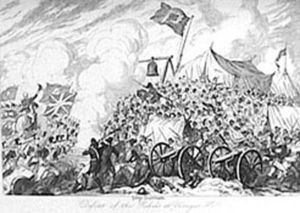 The Irish Rebellion of 1798 (Irish: Éirí Amach 1798), or 1798 rebellion as it is known locally, was an uprising in 1798, lasting several months, against the British dominated Kingdom of Ireland. The United Irishmen, a republican revolutionary group influenced by the ideas of the American and French Revolutions, were the main organizing force behind the rebellion

